
For most of my life, I didn’t understand why relationships felt so intense for me.
I loved deeply.
I cared deeply.
But with that love often came something else I couldn’t explain.
Fear.
Fear of losing the person I loved.
Fear of being replaced.
Fear that something could change at any moment.
At the time, I didn’t recognize these feelings as part of a larger pattern.
I thought they were just emotions.
Just reactions.
Just the way relationships made me feel.
It wasn’t until I began therapy and started doing the deeper work of understanding myself that I learned about something called anxious attachment.
And suddenly, so many pieces of my past started making sense.
Anxious attachment often develops early in life.
It grows out of environments where love or safety felt inconsistent.
Sometimes care was present.
Sometimes it wasn’t.
Sometimes reassurance was there.
Sometimes it disappeared.
As children, we learn how to adapt to the environments we grow up in.
And those adaptations don’t just disappear when we become adults.
They quietly follow us into our relationships.
For someone with anxious attachment, relationships can feel like emotional roller coasters.
When things feel good, they feel incredibly good.
But when something feels uncertain—even something small—it can trigger a deep sense of panic.
A delayed message.
A change in tone.
A moment of distance.
The mind begins racing.
“What did I do wrong?”
“Are they losing interest?”
“Are they about to leave?”
These thoughts aren’t always rational.
But they feel incredibly real.
And without understanding where they come from, they can shape the way we behave in relationships.
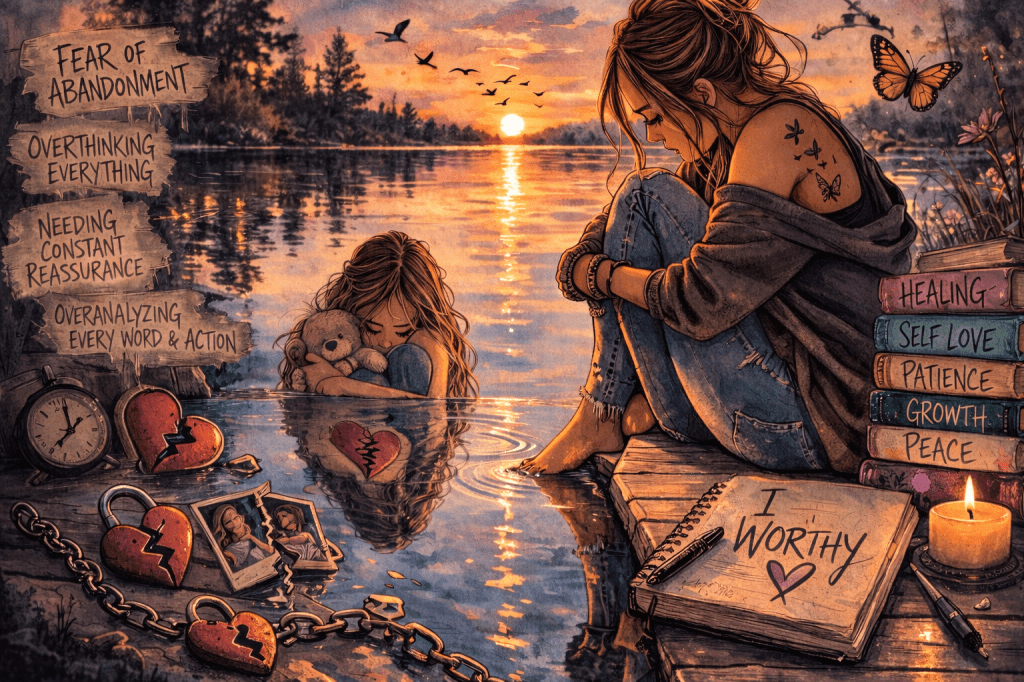
Sometimes we seek constant reassurance.
Sometimes we overanalyze every interaction.
Sometimes we react emotionally because our nervous system believes abandonment is right around the corner.
For a long time, I didn’t understand why I felt this way.
I just thought I was too emotional.
Too sensitive.
Too much.
But therapy helped me see something different.
These patterns weren’t flaws.
They were survival strategies I learned earlier in life.
My mind and body were trying to protect me from the kind of loss they once believed was possible at any moment.
Understanding that didn’t excuse every reaction I’ve ever had.
But it did give me something I had never had before.
Awareness.
And awareness changes everything.
Because once you begin to see the patterns, you also begin to understand how to slowly change them.
Healing anxious attachment isn’t about becoming someone who never cares deeply.
It’s about learning how to feel safe within yourself.
Learning how to pause instead of reacting.
Learning how to trust that distance doesn’t always mean abandonment.
It’s slow work.
But it’s powerful work.
And for the first time in my life, I can look back at my past relationships and understand not just what happened…
but why.










 Sit With Me Awhile
Leave a comment